
Loading...
Loading...
PEM often does not appear right away. Common timing patterns, why delayed onset is so difficult in daily life, and how to identify triggers more reliably.
Short answer
PEM can appear immediately, after several hours, or only one to three days after exertion.
The key issue is not an exact clock pattern, but a delayed and hard-to-attribute symptom worsening.
The stronger this delay effect is, the more important tracking and careful pacing become.
The delay is one of the main reasons PEM is hard to manage. If the real cost of an activity only shows up tomorrow or the next day, it becomes much harder to judge limits intuitively.
Key points
24 to 72 hours is a common window, but not the only one.
Timing may differ between physical, cognitive, and emotional triggers.
Without tracking, the trigger is easy to misread.
Delayed worsening does not mean the activity was safe.
Author
Frederik Marquart
Founder & CEO, Elara Health
Review
Elara Health Medical & Research Review
Scientific and patient-centered quality review
Last updated
April 15, 2026
Many people experience an activity as manageable at first. Only later do fatigue, cognitive problems, pain, sleep disruption, or autonomic symptoms become clearly worse.
That is one of the features that makes PEM so difficult. The body does not always signal overload in the moment; the impact may surface later.
A widely described pattern is worsening within 24 to 72 hours, but that is not a strict rule. Some people notice early changes on the same day, while others experience a more delayed decline.
This is why an exact number of hours is less important than watching for recurring patterns over several days after exertion.
immediately or within a few hours
the following day
two to three days later
in waves across several worse days
It helps to evaluate exertion in the context of the following days, not just the same day. Looking only at today often underestimates PEM.
Even simple tracking of activity, cognitive load, sleep, and symptoms can make delayed patterns much easier to spot.
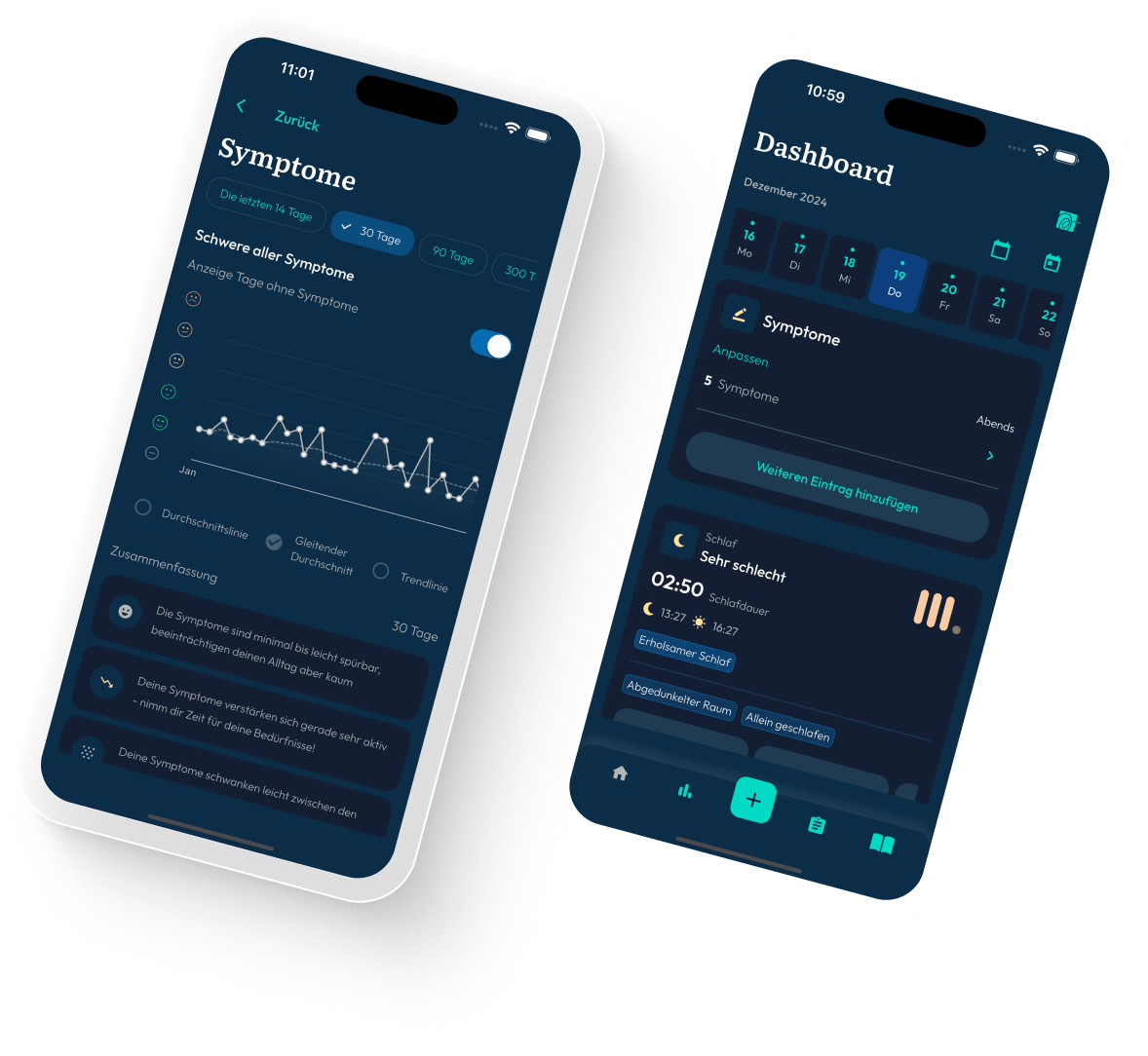
Track symptoms and exertion to recognise post-exertional malaise and crash patterns in time.
Yes. The 24-to-72-hour window is common, but it is not a hard boundary. Your own pattern matters more than any fixed number.
No. Delayed onset is one reason people may wrongly assume an activity was fine when it actually contributed to later worsening.
That is where tracking across several days becomes useful. It helps reveal which combinations of activity, stress, poor sleep, or sensory load repeatedly precede symptom worsening.
Every article is editorially reviewed, framed with medical context, and backed by primary sources you can verify.
Reviewed content with 3 sources
Educational context – not a substitute for medical diagnosis
Links to related knowledge, questionnaires, and methodology
PEM and pacing become more actionable when symptom burden and function are captured in a structured way.
Useful when delayed worsening after activity raises the question of ME/CFS-oriented symptom structure.
Best when daily limitation, recovery instability, and functional burden should be documented.
Compare all available assessments and choose the one that matches the real question.