
Loading...
Loading...
What post-exertional malaise is, how delayed onset works, how to recognize early warning signs – and how pacing and HRV tracking fit in.
Short answer
Post-exertional malaise is a disproportionate worsening of symptoms after physical, cognitive, or emotional exertion.
PEM often appears with a delay, which makes personal limits harder to recognize in real time.
The main levers are pattern recognition, careful pacing, and consistent tracking of exertion, symptoms, and recovery.
For many people with ME/CFS and Long COVID, PEM is the defining symptom. These pages provide clear, practical answers about delay, early signs, and careful exertion management instead of generic wellness advice.
Key points
PEM is more than normal tiredness after activity.
Delayed onset of 24 to 72 hours makes self-observation especially important.
Pacing is not total withdrawal; it is a strategy to stabilize daily function.
Wearables and HRV can provide signals, but they still need symptom context.
Author
Frederik Marquart
Founder & CEO, Elara Health
Review
Elara Health Medical & Research Review
Scientific and patient-centered quality review
Last updated
April 15, 2026
Tiredness after exertion is universal. PEM is different: a disproportionate worsening of multiple symptoms – fatigue, cognitive dysfunction, pain, sleep disruption, autonomic symptoms – following physical, cognitive, or emotional exertion.
The hallmark is delay: PEM often appears only hours, or one to three days, after the trigger. That timing gap makes it hard to recognize when limits have been crossed in the moment.
Pacing is not total withdrawal but a strategy to align activity with current capacity. Structured tracking of symptoms, exertion, and recovery reveals patterns earlier and makes crashes easier to avoid.
Wearables and HRV data can add signals – but they do not replace symptom context. The main levers remain pattern recognition, careful planning, and realistic capacity limits.
A delay of 24–72 hours is typical
Recognize and document early signs in time
Pacing as a stabilization strategy, not just rest
HRV and tracking as signals, not replacements
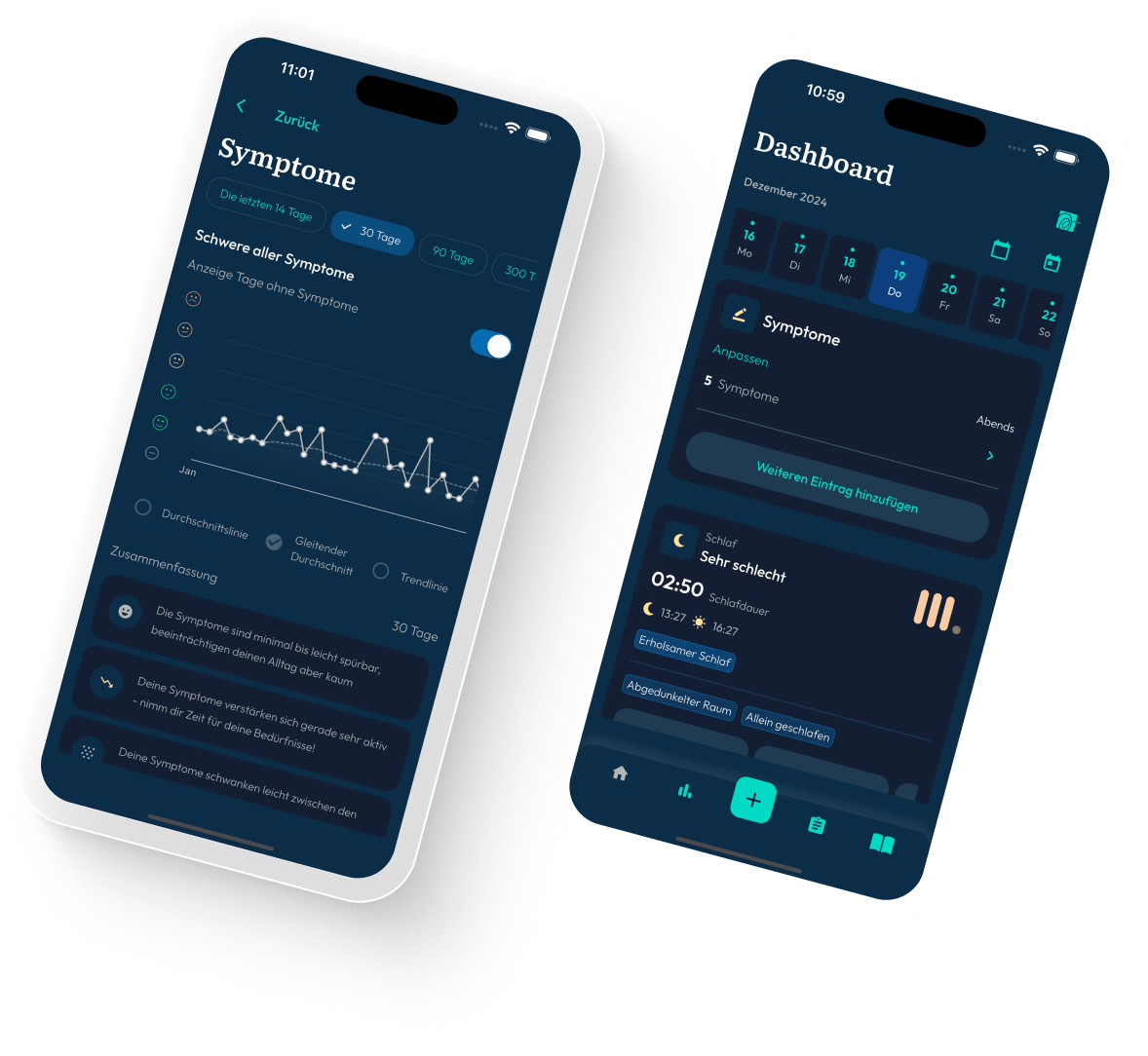
Track symptoms and exertion to recognise post-exertional malaise and crash patterns in time.
No. PEM means a disproportionate worsening of multiple symptoms after exertion. That can include fatigue, cognitive dysfunction, pain, sleep disruption, or autonomic symptoms.
Yes. Delayed onset is a defining feature. For many people, symptoms become clearly worse hours later or even one to three days after the trigger.
Yes. Tracking exertion, symptoms, sleep, and recovery makes it easier to see patterns and adjust activity more cautiously.
Every article is editorially reviewed, framed with medical context, and backed by primary sources you can verify.
Reviewed content with 3 sources
Educational context – not a substitute for medical diagnosis
Links to related knowledge, questionnaires, and methodology
PEM and pacing become more actionable when symptom burden and function are captured in a structured way.
Useful when delayed worsening after activity raises the question of ME/CFS-oriented symptom structure.
Best when daily limitation, recovery instability, and functional burden should be documented.
Compare all available assessments and choose the one that matches the real question.
Definition, timing, and key features of PEM.
Why a delay of hours to days matters so much.
The key differences in timing, severity, and recovery.
Which patterns often show up before symptom worsening.
Why a crash can keep shaping the next hours, days, or longer.
How careful load management can reduce the impact of PEM in daily life.
Why PEM is so central to understanding the illness.