
Loading...
Loading...
What ME/CFS is, which symptoms and criteria matter, how it differs from Long COVID, burnout, or depression – and why PEM is central.
Short answer
ME/CFS is a severe chronic multisystem illness in which exertion often leads to a disproportionate and delayed worsening of symptoms.
PEM, cognitive dysfunction, sleep disturbance, pain, and autonomic symptoms are often central features.
Because ME/CFS is frequently misunderstood, clear differentiation, structured symptom tracking, and realistic load management matter a lot.
ME/CFS is still widely misunderstood. Clear, precise, and practical explanations help affected people build a reliable understanding – medically framed, focused on symptoms and daily life.
Key points
PEM is one of the central features of ME/CFS.
ME/CFS is not simply tiredness, burnout, or deconditioning.
The illness can affect physical, cognitive, and autonomic systems at the same time.
Early clarity about patterns, triggers, and personal limits is crucial in daily life.
Author
Frederik Marquart
Founder & CEO, Elara Health
Review
Elara Health Medical & Research Review
Scientific and patient-centered quality review
Last updated
April 15, 2026
ME/CFS is more than chronic tiredness. Exertion – physical, cognitive, or emotional – can trigger a delayed and disproportionate worsening of symptoms, often only hours or days later. This pattern is called post-exertional malaise (PEM) and is considered the core feature of the illness.
Beyond PEM, cognitive limitations ("brain fog"), unrefreshing sleep, autonomic symptoms (e.g. orthostatic intolerance), and pain are common. Severity ranges from mildly limited to bedbound – an ME/CFS diagnosis does not rule out that someone may still be partly active.
Burnout, depression, or simply "too much stress" are often mistakenly equated with ME/CFS. Symptoms can overlap, but the delayed worsening pattern after exertion clearly distinguishes ME/CFS.
The assumption that more activity helps ("graded exercise therapy") has been retracted by recent guidelines – overexertion can cause lasting deterioration. Pacing and realistic capacity limits are now the focus.
PEM is not "normal tiredness after exertion"
ME/CFS is not psychologically caused
More movement does not automatically help – it can harm
Severity varies widely between individuals
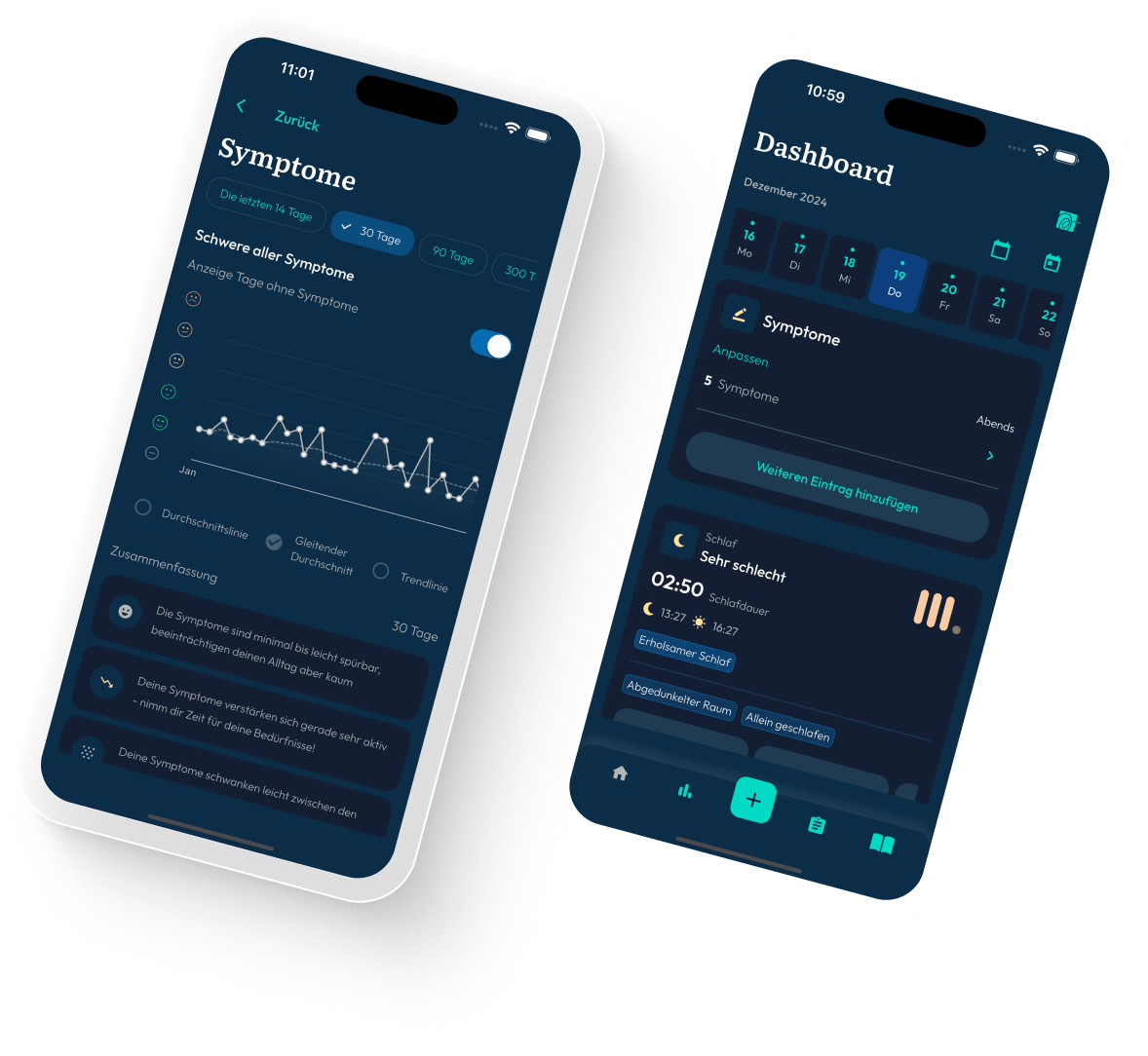
Record symptoms, exertion, and recovery to understand your trajectory – with the Elara app.
No. Tiredness is only part of the picture. ME/CFS often affects multiple systems at once and is especially shaped by PEM, cognitive dysfunction, and markedly reduced capacity.
Yes. Delayed and disproportionate worsening after exertion is considered one of the central features of the illness.
Yes. Structured tracking of symptoms, exertion, sleep, and recovery can help reveal patterns and support more informed conversations with professionals.
Every article is editorially reviewed, framed with medical context, and backed by primary sources you can verify.
Reviewed content with 3 sources
Educational context – not a substitute for medical diagnosis
Links to related knowledge, questionnaires, and methodology
Use questionnaires when explanation should turn into structured symptom capture, diagnostic orientation, or severity documentation.
Best when the main question is whether the symptom pattern fits ME/CFS-oriented criteria.
Use when function, daily limitation, and severity need clearer structure over time.
Review purpose, limits, and safe interpretation before treating any score as a conclusion.
The compact starting point for definition and key features.
Which patterns and frameworks are often relevant.
Where overlap exists and where differentiation matters.
When a Long COVID course begins to look more like ME/CFS and why PEM matters so much.
Where symptoms overlap and why differentiation still matters.