
Loading...
Loading...
When a Long COVID course starts to look more like ME/CFS – and why PEM, reduced capacity, and recovery patterns matter so much.
Short answer
Yes, Long COVID can evolve into a course that strongly resembles ME/CFS.
This becomes especially relevant when PEM, clearly reduced capacity, brain fog, and impaired recovery after activity shape the picture.
What matters most is not the label alone, but the pattern of exertion response, symptom course, and daily function.
Many people notice that post-COVID symptoms do not only persist, but begin to form a pattern that looks increasingly like ME/CFS. For affected people, that transition question is often more useful than a purely semantic debate.
What matters most
Long COVID is a broad umbrella term, while ME/CFS is a more specific illness pattern.
PEM is one of the strongest clues that the course is becoming more ME/CFS-like.
Not every persistent post-COVID symptom pattern automatically equals ME/CFS.
In practical terms, the question matters most when activity repeatedly leads to clear setbacks.
Author
Frederik Marquart
Founder & CEO, Elara Health
Review
Elara Health Medical & Research Review
Scientific and patient-centered quality review
Last updated
April 23, 2026
Many people begin with persistent symptoms after infection and only later notice that capacity keeps shrinking, recovery gets harder, and activity triggers worsening hours or days later.
That is often the point where the course starts to feel less like a broad Long COVID label and more like a specific ME/CFS pattern.
The most important clue is PEM: disproportionate and often delayed worsening after physical, cognitive, or emotional exertion.
Other common features include markedly reduced capacity, brain fog, sleep problems, orthostatic symptoms, or the feeling that even small demands have outsized consequences.
PEM or clearly exertion-linked crashes
markedly reduced capacity
cognitive worsening after activity
recovery stretched across several days
If the course becomes more ME/CFS-like, the most useful daily strategies often change. Careful load management, pacing, and better longitudinal tracking become much more important.
The point is not to collapse every post-COVID case into one label, but to take PEM and exertion response seriously enough to change decisions.
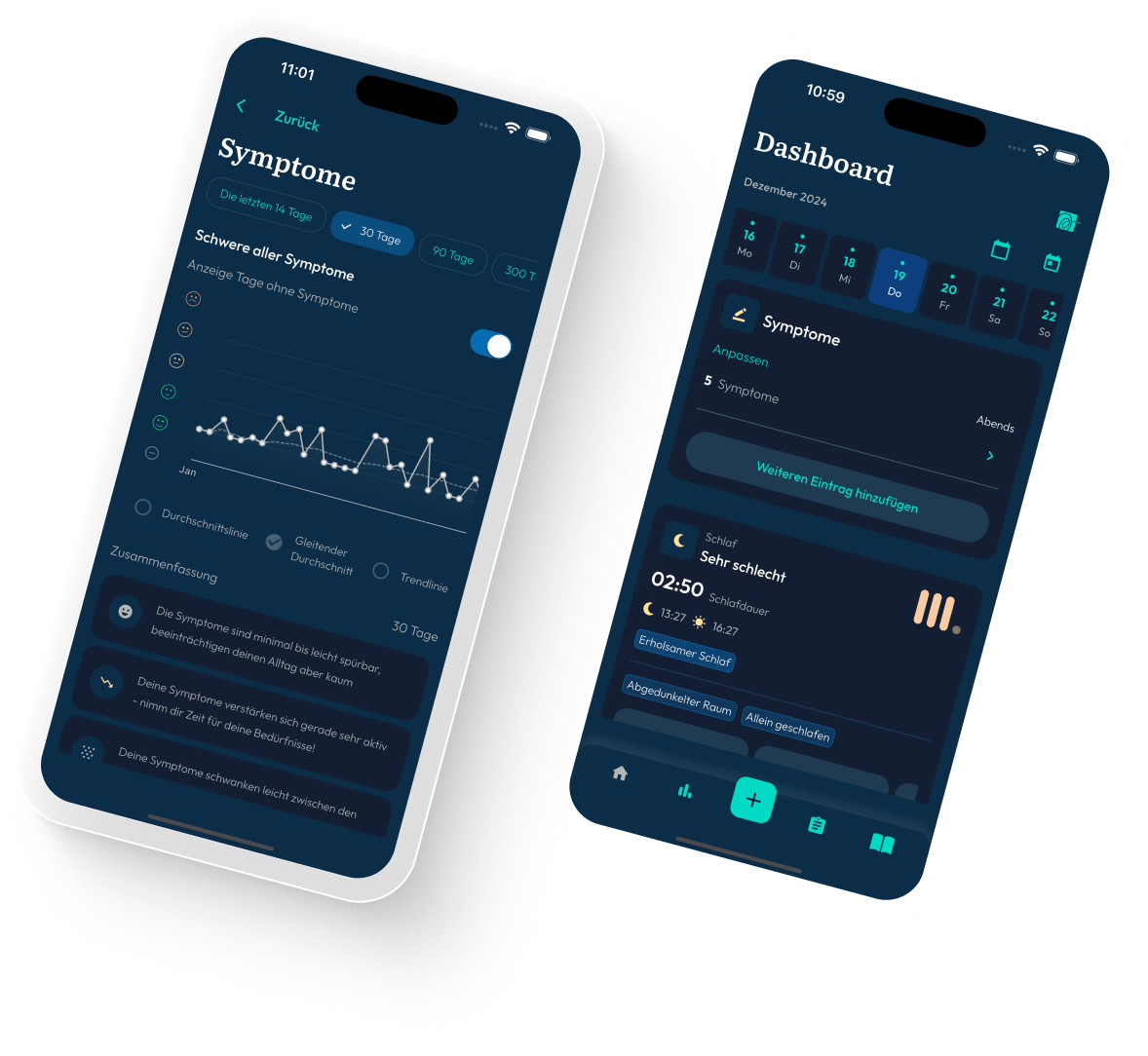
Record symptoms, exertion, and recovery to understand your trajectory – with the Elara app.
No. Long COVID remains a broad umbrella term. Only some courses develop a clearly ME/CFS-like pattern.
PEM is one of the strongest clues, especially when activity repeatedly leads to delayed and marked worsening.
Because load management, pacing, and cautious planning become much more important once activity itself is part of the problem.
No. In daily life, the important issue often appears earlier: whether PEM, reduced capacity, and difficult recovery are shaping the course. That pattern can matter even before formal diagnostic clarification is complete.
Every article is editorially reviewed, framed with medical context, and backed by primary sources you can verify.
Reviewed content with 4 sources
Educational context – not a substitute for medical diagnosis
Links to related knowledge, questionnaires, and methodology
Use questionnaires when explanation should turn into structured symptom capture, diagnostic orientation, or severity documentation.
Best when the main question is whether the symptom pattern fits ME/CFS-oriented criteria.
Use when function, daily limitation, and severity need clearer structure over time.
Review purpose, limits, and safe interpretation before treating any score as a conclusion.