
Loading...
Loading...
How heart rate, HRV, and the anaerobic threshold can make the invisible exertion limit in PEM visible – and where the limits of wearables lie.
Short answer
Wearables cannot reliably predict a PEM crash, but they make exertion and recovery measurable when they would otherwise stay invisible.
Heart-rate pacing – staying below an individual heart-rate ceiling – is the best-studied wearable approach for PEM.
A low morning HRV or an elevated resting heart rate can point to incomplete recovery and a higher crash risk.
Wearable data do not replace symptom tracking – they are strongest in combination.
The tricky part of PEM is the delay: during exertion much of it still feels manageable, and the price arrives only hours or days later. This is exactly where wearable data such as heart rate and heart-rate variability (HRV) can help – they make visible an exertion limit that is barely noticeable in the moment. This page explains how that works, what the research says, and where the limits are.
Key points
PEM is delayed – measurements can make overexertion visible earlier than how it feels.
Heart-rate pacing aims to stay below the anaerobic threshold.
HRV is a clue to autonomic recovery, not a diagnostic value.
Wearables are not medical devices – an individual baseline and medical guidance still matter.
Author
Frederik Marquart
Founder & CEO, Elara Health
Review
Elara Health Medical & Research Review
Scientific and patient-centered quality review
Last updated
June 12, 2026
In PEM, “stay below your exertion limit” is central advice – but where exactly that limit lies is hard to feel in the moment. Because the worsening often sets in only 12 to 72 hours later, the immediate feedback that warns healthy people about overload is missing.
Objective measurements can partly close that gap. Heart rate and HRV respond to exertion before a crash shows up as a symptom – making visible a limit that subjectively only registers too late.
With heart-rate pacing, you set an individual heart-rate ceiling and try to stay below it in daily life. The idea: above a certain threshold the body shifts more toward anaerobic metabolism, which in ME/CFS can disproportionately contribute to PEM.
A common starting point in the ME/CFS community is a rough estimate of about 60 percent of maximum heart rate (roughly (220 − age) × 0.6). That is only a starting point – the actual threshold is individual and is ideally refined with a therapist or through an exercise test.
An individual heart-rate ceiling instead of fixed activity rules
A wrist heart-rate alert makes exceedances noticeable right away
Especially helpful with orthostatic load (standing, stairs)
Goal: fewer anaerobic spikes, fewer delayed crashes
The anaerobic or ventilatory threshold (VT1) marks the point where energy metabolism becomes increasingly anaerobic. Work by the Workwell Foundation using an exercise test on two consecutive days (2-day CPET) shows that this threshold drops on the second day in ME/CFS – an objective sign of impaired recovery after exertion.
In practice this means the heart rate at VT1 can serve as a personal ceiling. Staying below it engages the anaerobic range less often – a key building block for triggering crashes less frequently.
Heart-rate variability (HRV) describes the variation in the intervals between heartbeats and is seen as a clue to the state of the autonomic nervous system. A low morning HRV relative to your own baseline, or an elevated resting heart rate, can mean the body has not yet fully recovered.
In ME/CFS and long COVID, early studies suggest such autonomic markers relate to exertion intolerance and symptom severity. As a single value HRV is noisy – it becomes useful only as a trend over several days and when compared with the symptom course.
Always read HRV as a personal trend, not an absolute value
Low HRV plus elevated resting heart rate can signal incomplete recovery
Mind confounders: sleep, alcohol, infection, menstrual cycle, timing
Its meaning grows when matched with documented symptoms
The real value emerges when heart rate, HRV, resting heart rate, sleep, and activity are viewed together over time. From that pattern, early hints of an approaching worsening can be derived before the crash is felt – this is exactly the approach behind Elara’s PEM early-warning.
The honest framing matters: this is about probabilities and early warnings, not a guarantee. No algorithm can reliably predict a crash. The data prompt you to plan more defensively – the decision still rests with the person, ideally together with the symptom diary.
Consumer wearables are not validated medical devices, and their accuracy varies by device and situation. Numbers should relieve pressure, not add it – constantly chasing “better” values can itself become a burden.
For severely affected people, even wearing or reviewing a device can be too much. Wearable data are a pacing aid, not a replacement: most valuable as an additional, individually calibrated clue alongside your own perception and medical guidance.
Track symptoms and exertion to recognise post-exertional malaise and crash patterns in time.
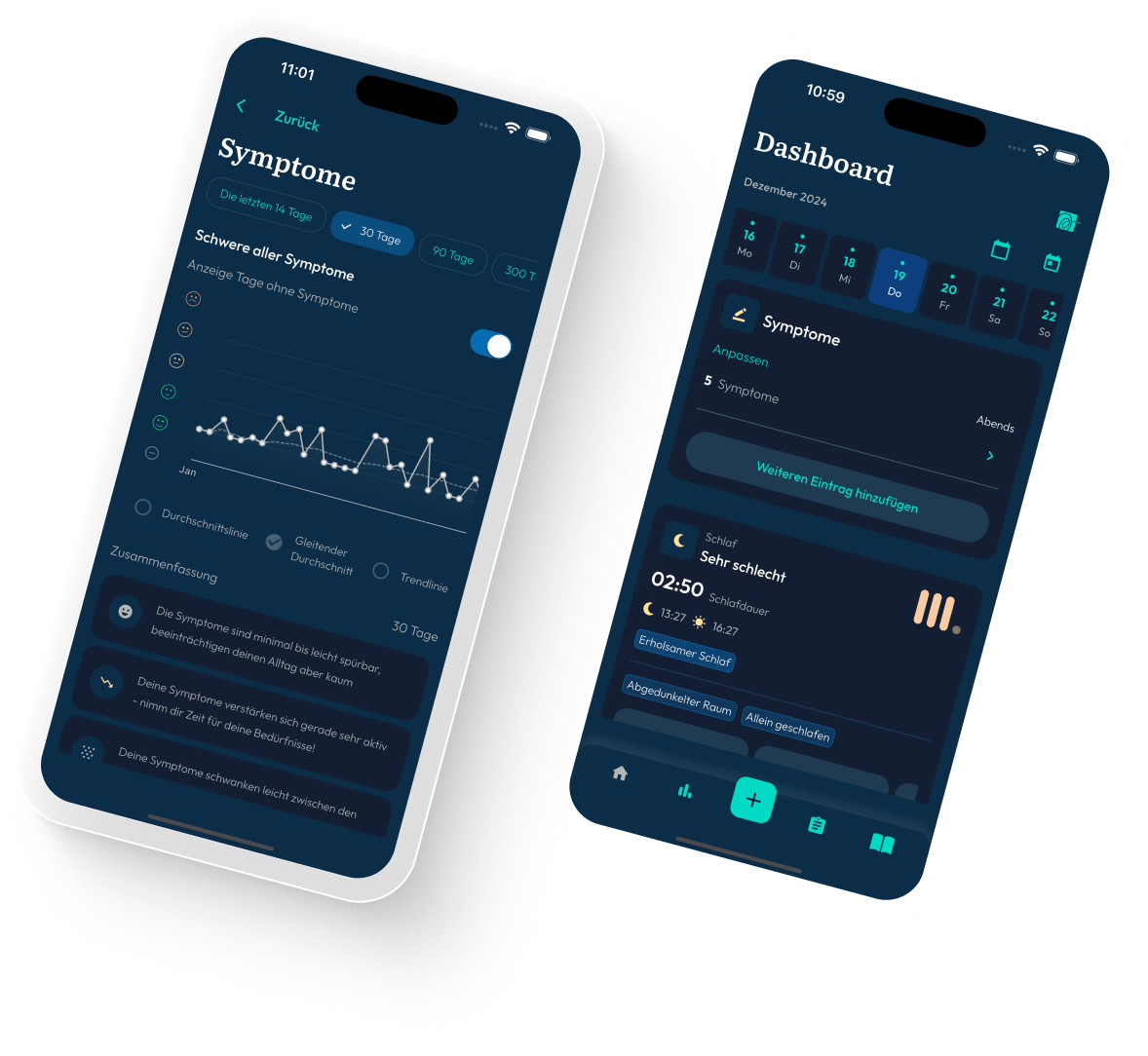
Not with certainty. But wearables can make exertion and recovery measurable and, through patterns in heart rate, HRV, and resting heart rate, give early hints of a higher crash risk. That is an early warning, not a guarantee.
A common rough orientation is about 60 percent of maximum heart rate (roughly (220 − age) × 0.6). The actual threshold is individual and should ideally be determined with a therapist or through an exercise test.
It marks the point where metabolism becomes increasingly anaerobic. In ME/CFS it is often low and drops further after exertion. Staying below it helps many people trigger crashes less often.
HRV is a clue to autonomic recovery. A low HRV relative to your own baseline can suggest incomplete recovery. It is meaningful only as a trend over several days and when compared with symptoms.
No. Data and symptom tracking complement each other. Only the combination of measurements and lived symptoms truly reveals individual patterns and exertion limits.
What matters is not the brand but reliable heart-rate and ideally HRV measurement, plus using the data consistently and in a way that relieves pressure. A chest strap usually measures heart rate more accurately than optical wrist sensors.
Every article is editorially reviewed, framed with medical context, and backed by primary sources you can verify.
Reviewed content with 4 sources
Educational context – not a substitute for medical diagnosis
Links to related knowledge, questionnaires, and methodology
PEM and pacing become more actionable when symptom burden and function are captured in a structured way.
Useful when delayed worsening after activity raises the question of ME/CFS-oriented symptom structure.
Best when daily limitation, recovery instability, and functional burden should be documented.
Compare all available assessments and choose the one that matches the real question.
Open source
Open source
Open source
Open source